
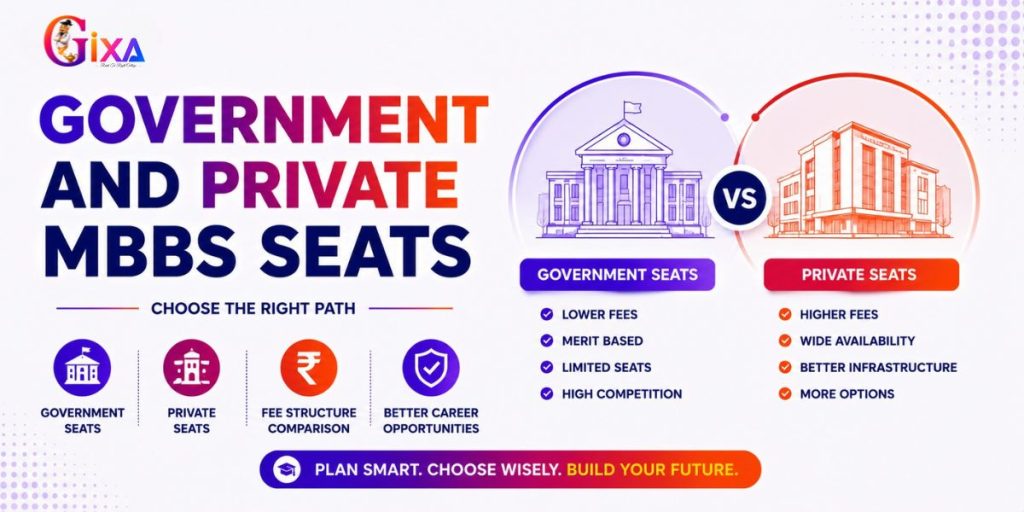
Government and Private MBBS Seats: Complete Guide for MBBS Aspirants
Medical education remains one of the most sought-after career paths in India. Every year, lakhs of students appear for NEET with the dream of securing an MBBS seat. However, understanding the difference between government and private MBBS seats is essential before participating in the admission process. From fee structure and eligibility criteria to counseling procedures and seat availability, students must be aware of all important aspects to make informed decisions.
In this guide, we will explore everything you need to know about government and private MBBS seats in India.
Government MBBS Seats in India: Eligibility, Fees, and Benefits
Government MBBS seats are offered by medical colleges funded by the central or state government. These seats are highly competitive because they provide quality education at significantly lower fees.
The primary eligibility requirement is qualifying NEET with the required cutoff marks. Admission is granted through All India Quota (AIQ) counseling and State Quota counseling.
Benefits of Government MBBS Seats
- Affordable tuition fees
- High-quality medical education
- Better clinical exposure due to higher patient inflow
- Recognized and reputed institutions
- Lower financial burden on students and families
The annual fees in government medical colleges generally range from ₹10,000 to ₹1,50,000, depending on the institution and state regulations.
The primary eligibility requirement is qualifying NEET with the required cutoff marks. Admission is granted through All India Quota (AIQ) counseling and State Quota counseling.
Private MBBS Seats in India: Admission Process and Fee Structure
Private MBBS seats are available in privately managed medical colleges approved by the National Medical Commission (NMC). These colleges offer additional opportunities for students who may not secure government seats.
Admission to private colleges also requires NEET qualification. However, the cutoff scores are often comparatively lower than those of government colleges.
Advantages of Private MBBS Seats
- More seat availability
- Increased admission opportunities
- Modern infrastructure and facilities
- Diverse college options across India
The annual fee for private MBBS colleges can range from ₹8 lakh to ₹30 lakh or more, depending on the institution and seat category.
Government vs Private MBBS Seats: Key Differences
Choosing between government and private MBBS seats requires careful consideration of several factors.
Fee Structure
Government colleges offer significantly lower fees compared to private institutions. This is one of the biggest deciding factors for many students.
NEET Cutoff
Government MBBS seats usually have higher cutoff scores because of intense competition. Private colleges may have comparatively lower cutoff requirements.
Seat Availability
Private medical colleges collectively offer a large number of MBBS seats, increasing admission possibilities for candidates.
Infrastructure and Facilities
Many private medical colleges provide advanced infrastructure, smart classrooms, and modern laboratories. Government colleges, however, often offer stronger clinical exposure through larger patient volumes.
Return on Investment
Government colleges provide a higher return on investment due to lower educational costs. Students graduating from both government and private colleges receive the same MBBS degree recognized by NMC.
MBBS Counseling Process for Government and Private Seats
The counseling process is crucial for securing admission into MBBS programs.
All India Quota Counseling
The Medical Counseling Committee (MCC) conducts counseling for 15% of government medical seats under the All India Quota, as well as seats in deemed universities and certain central institutions.
State Quota Counseling
Each state conducts counseling for 85% of government college seats and many private college seats within the state.
Documents Required
Students generally need:
- NEET scorecard
- Admit card
- Class 10 and 12 mark sheets
- Identity proof
- Category certificate (if applicable)
- Domicile certificate (for state quota)
Proper document verification is essential during the counseling process.
MBBS Seat Matrix and Availability in India
The number of MBBS seats in India has increased significantly in recent years. Both government and private medical colleges continue to expand their intake capacity to meet growing healthcare demands.
Students should regularly check official counseling portals for updated seat matrices, category-wise distribution, and admission schedules. Understanding seat availability can help candidates make strategic choices during counseling rounds.
How to Choose Between Government and Private MBBS Seats
The decision depends on several personal and financial factors.
Consider the following:
- NEET score and rank
- Budget and financial planning
- Preferred location
- College reputation
- Clinical exposure opportunities
- Infrastructure and learning environment
Students with strong NEET scores generally prioritize government colleges due to affordability. However, private colleges can also provide excellent education and career opportunities when chosen carefully.
Conclusion
Understanding the differences between government and private MBBS seats is crucial for every medical aspirant. Government colleges offer affordable education and strong clinical exposure, while private colleges provide additional opportunities and modern facilities. By evaluating factors such as fees, NEET score requirements, counseling procedures, and career goals, students can make informed decisions and maximize their chances of securing an MBBS seat.
Before participating in counseling, thoroughly research available colleges, compare options, and stay updated with official admission notifications. A well-planned approach can help you successfully begin your journey toward becoming a doctor.
FAQ
What is the difference between government and private MBBS seats?
Government MBBS seats are offered by state or central government-funded colleges with lower fees, while private MBBS seats are available in privately managed colleges with higher fee structures.
Is MBBS abroad valid in India?
Yes, qualifying NEET is mandatory for admission to both government and private MBBS colleges in India.
What are the fees for government MBBS seats?
Government MBBS college fees generally range from ₹10,000 to ₹1,50,000 per year, depending on the institution.
What are the fees for private MBBS seats?
Private MBBS college fees can range from ₹8 lakh to ₹30 lakh or more per year based on the college and seat category.
Are private MBBS degrees valid in India?
Yes, MBBS degrees from NMC-approved private medical colleges are fully valid and recognized across India.
Which is better: government or private MBBS seats?
Government MBBS seats are preferred for affordability, while private MBBS seats provide additional admission opportunities and often better infrastructure.
How are MBBS seats allotted?
MBBS seats are allotted through NEET-based counseling conducted by MCC and respective state counseling authorities.
Can I get a private MBBS seat with a lower NEET score?
Yes, private medical colleges often have lower cutoff scores compared to government colleges, though NEET qualification remains mandatory.